The Gap Between Consumer Signals and Company Decisions
A capable language model can produce a convincing account of cultural change. A company deciding where to innovate still needs to establish what that account supports. Demand for longer-lasting products might suggest better materials, easier repair or a service that removes the burden of maintenance. Each interpretation points toward a different business. The research task is to determine which explanation holds, for whom, and what the company would need to change to act on it.
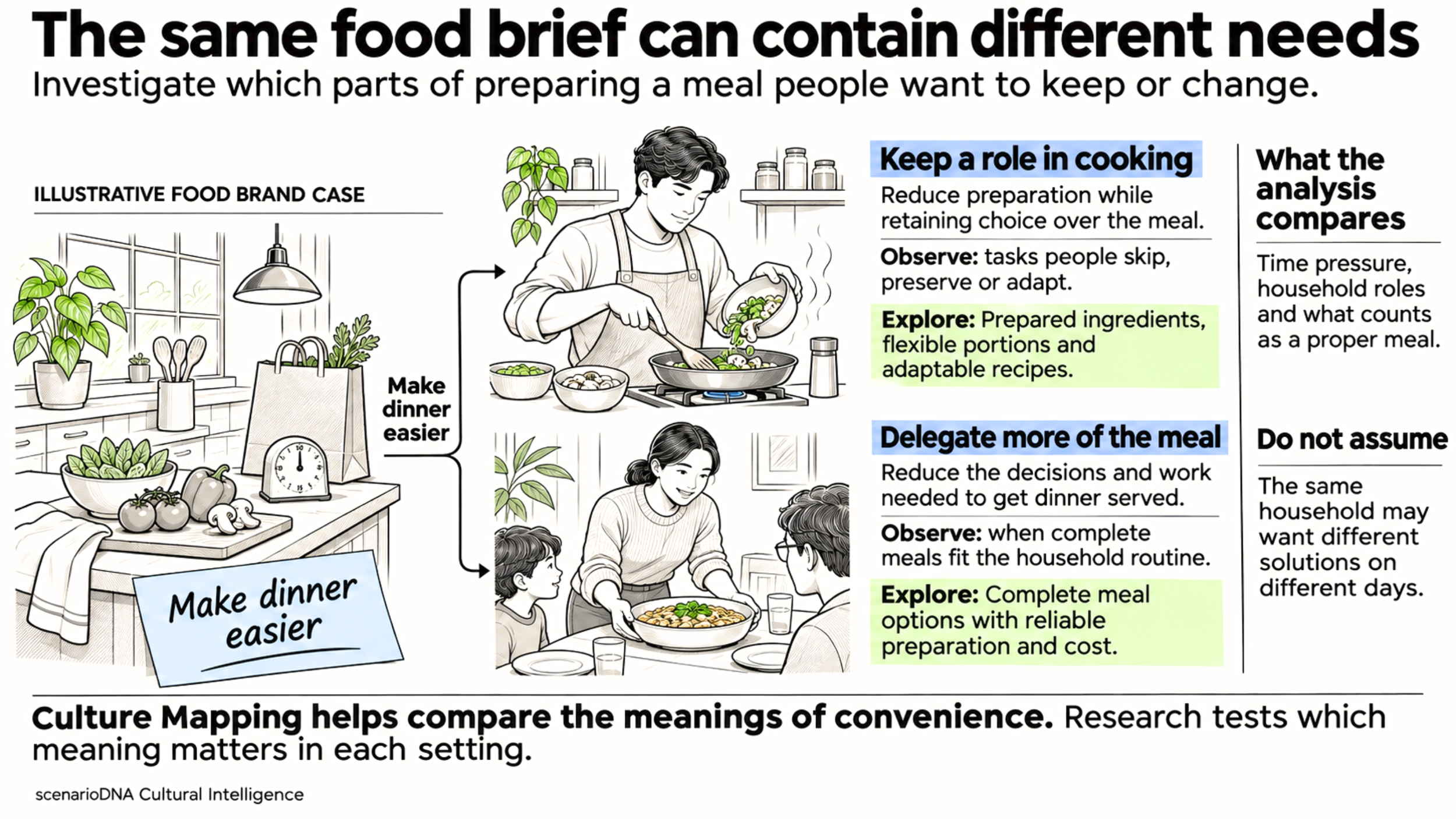
General models can investigate these differences when given suitable instructions and evidence. They do not, by themselves, establish a consistent research method across an organization’s projects. Without one, studies conducted six months apart may organize similar evidence differently. Researchers then have difficulty distinguishing a change in culture from a change in the analysis. scenarioDNA’s Culture Mapping supplies a consistent reference for examining those differences and developing an investigation over time.
Developed through cultural research and computational linguistics, Culture Mapping examines how language and behavior carry meaning in particular settings. It helps researchers compare what a practice expresses, which conventions it supports or challenges, and how those relationships differ across communities. In the example of product longevity, maintaining equipment could express independence and practical expertise. Delegating maintenance could express a desire to concentrate resources elsewhere. Similar requests for durability would then have different implications for product design, service provision and the capabilities a company needs.
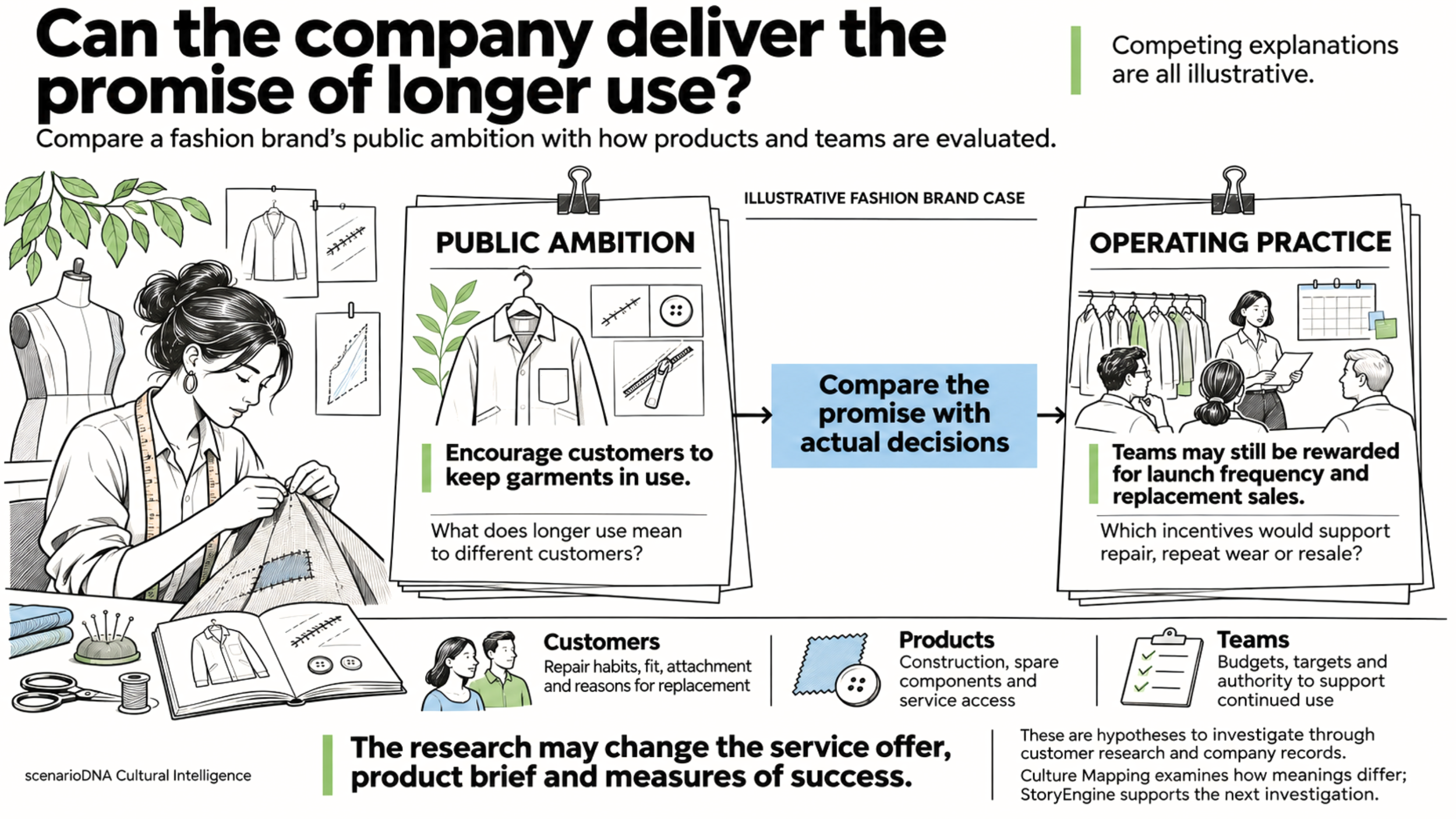
StoryEngine applies this framework alongside other structured research techniques through an inquiry the researcher directs. Its specialist assistants support successive investigations, while its Integration workflow helps researchers check findings against evidence and prepare the next question. A proposed opportunity can be examined through competing explanations before becoming a recommendation. When source context and the reasons for earlier conclusions are retained, later research can establish what has changed and whether the original interpretation still holds.
The same approach can examine a company’s ability to innovate. Leaders may describe a shortage of ideas while teams describe proposals that cannot obtain a trial, an owner or an operating budget. Those accounts require investigation rather than an immediate verdict about company culture. Comparing the language of innovation with actual project decisions can help establish where the constraint lies. The appropriate response might involve research skills, evaluation criteria or authority to run experiments. Another ideation workshop would address only some of those possibilities.
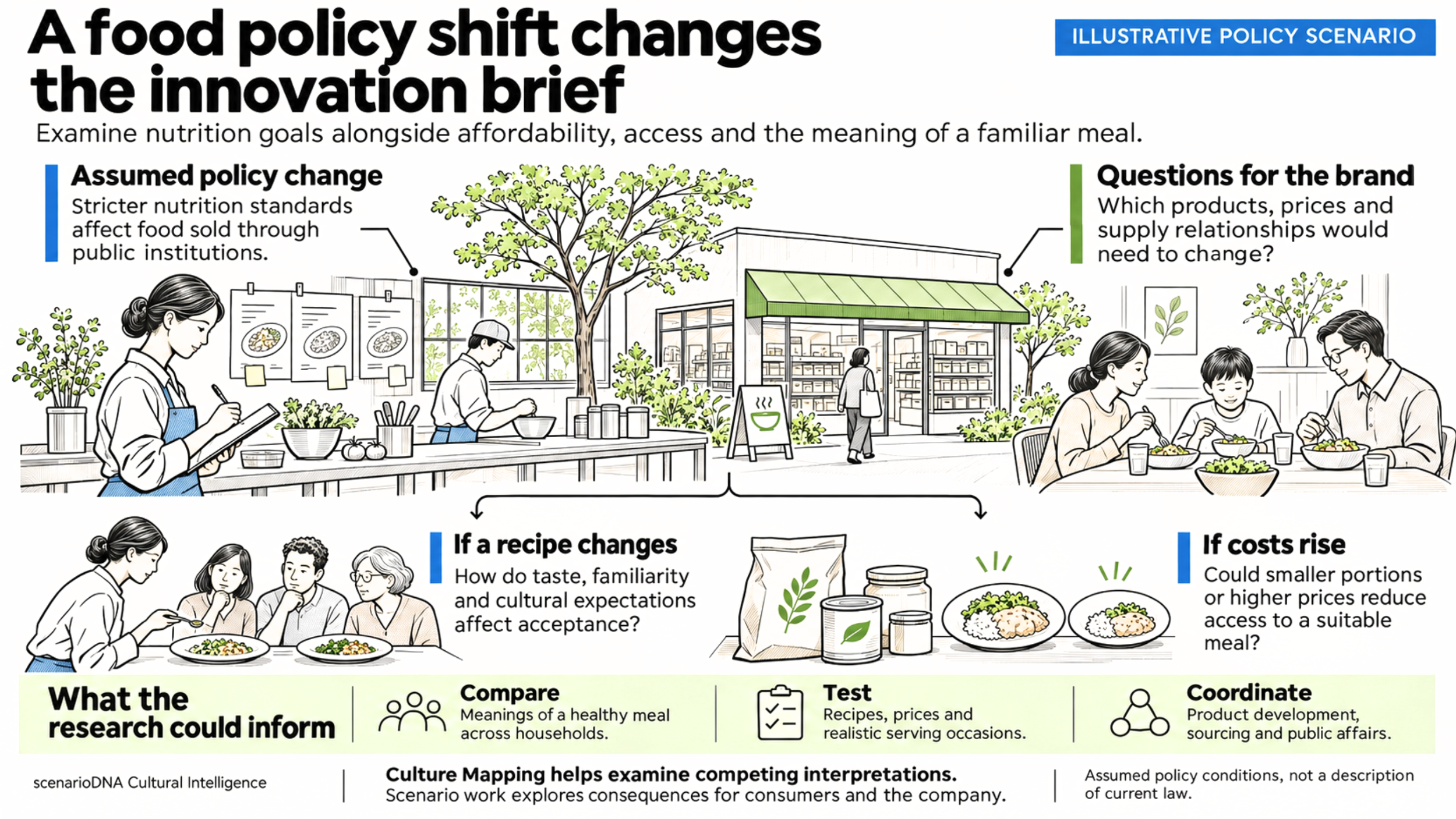
Broader policy shifts can change the conditions under which a company’s capabilities remain useful. Consider a scenario in which producers take greater responsibility for products after use. A manufacturer would need to examine potential changes in customer expectations and repair practices alongside its compliance obligations. Product development might need closer coordination with service teams; procurement might need different supplier relationships. Policy organizations would also need to investigate who bears collection costs and whether access to repair improves. Cultural research can examine how the affected groups understand responsibility, while scenario work explores the consequences under different arrangements.
This work has a computational foundation that predates current generative AI products. U.S. Patent No. 9,002,755, granted to scenarioDNA in 2015, describes computer-implemented processes that apply semiotic analysis to unstructured language, associate it with behavioral archetypes and map relationships, including movement over time. A 2016 publication documents the method’s development through ethnographic research and its extension through natural language processing and machine learning. StoryEngine brings aspects of this methodology and scenarioDNA’s broader research practice into a generative AI environment.
As models improve, researchers can examine larger collections of material and compare language with images, speech and observed practices. A consistent method provides a basis for evaluating what those capabilities contribute. Researchers can check whether a new model preserves differences between stakeholder positions, finds evidence that challenges an opportunity or identifies an organizational assumption that needs testing. Greater processing capacity becomes useful when it improves the investigation.
For organizations investing in research and AI, the immediate value is a defined method they can apply to evidence they already hold. An innovation team can investigate which opportunity deserves a prototype and what it would take to deliver it. A strategy group can examine whether its organization is equipped for changing conditions. A policy team can explore how an intervention might redistribute opportunity and obligation. These inquiries connect cultural change to practical choices about what to develop, what to learn and how the organization needs to adapt.