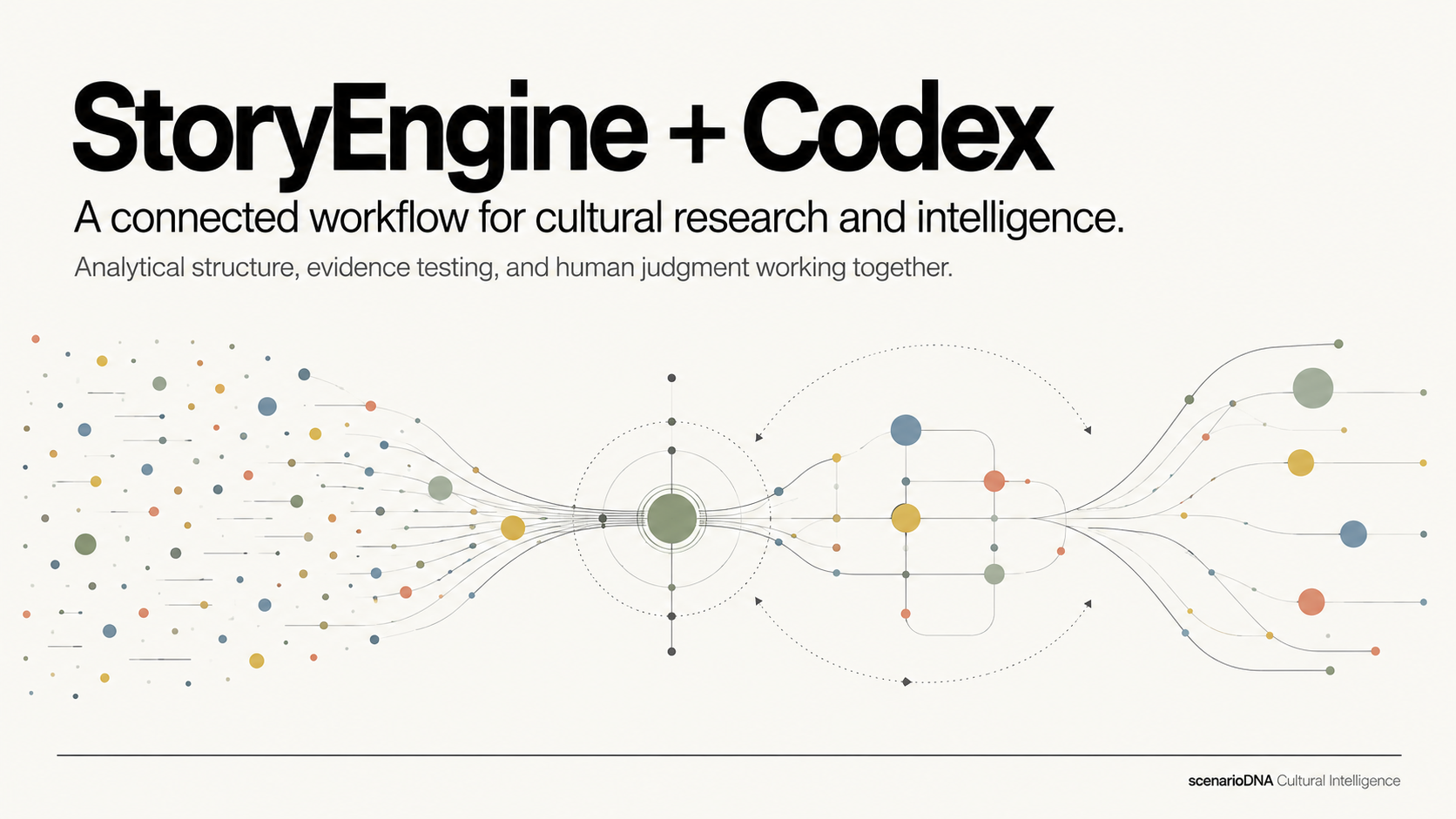
StoryEngine and Codex can now carry one research question from the first signal scan to the finished work. StoryEngine’s assistants map how the signals around a question relate, from the words people use to the symbols that keep recurring. They sort those signals into taxonomies and competing readings. StoryEngine also sets out the knowns and unknowns as story spaces with their own taxonomies, so an analyst can map an open question rather than leave it on a list of gaps.
The StoryEngine Integration plugin lets Codex carry that work between assistants. Codex opens each assistant in the browser and gives it the findings from the stage before. It brings back the questions that assistant raised for the next round. An analyst can move a question from a signal scan into a contrarian reading without retyping the findings.
StoryEngine structures a question and leaves verification to research tools such as Perplexity. Those tools check the claims in each reading against current sources and mark each one supported, contradicted or unresolved. Codex takes those results back into StoryEngine and, where a source contradicts a claim, reopens the earlier reading or rewrites the next question. A reviewer can open the log of every pass and trace any conclusion back to the sources and readings behind it.
The analyst weighs the evidence and decides what it means for strategy. We turn that work into reports, visual presentations and simulations. In each one, a reader can see which statements come from current sources and which are our reading of them. We label every scenario as a possible future.